How To Mix Peptides With Bac Water How to mix peptides with bacteriostatic water
Introduction: Getting peptide reconstitution right (and avoiding the mistakes that waste doses)
If you’ve ever watched a carefully prepared vial turn cloudy, smell “off,” or lose effectiveness too quickly, you already know reconstitution isn’t just a lab step—it’s the difference between getting a usable dose and throwing product away. In my hands-on peptide workflow, I treat “how to mix peptides with bac water” as a precision process: clean technique, correct volumes, and calm, repeatable mixing. This guide walks you through a practical, step-by-step method for reconstituting peptides using bacteriostatic water (BAC water), plus troubleshooting and quality checks so you can be confident in what’s in your vial.
What “bac water” does (and why it changes how you mix)
Bacteriostatic water (BAC water) is sterile water containing a bacteriostatic agent designed to inhibit microbial growth. That doesn’t sterilize your peptide—your aseptic technique still matters—but it helps protect the reconstituted solution from contamination over a limited time window.
From a real-world perspective, this is why mixing method matters:
- Gentle mixing preserves consistency: Peptides often need rehydration; aggressive shaking can introduce bubbles and may increase the chance of inconsistent appearance.
- Clean handling reduces risk: Since you’re preparing a solution meant to sit for some period, contamination prevention is central.
- Accurate volume affects concentration: Even small volume errors can throw off your intended dosage concentration.
In my experience, the biggest failures come from impatience (not letting powder fully wet), sloppy measurement, or touching non-sterile surfaces after breaking sterility.
Before you start: supplies, setup, and the “no-surprises” checklist
Start by organizing everything so you’re not searching for items with a needle in hand. I use the same checklist every time because it reduces variability.
Supplies you’ll typically need
- Peptide vial (lyophilized powder)
- Bacteriostatic water (BAC water)
- Sterile syringes and needles (or appropriate withdrawal devices)
- Alcohol swabs
- Clean, flat workspace
- Gloves
- Sharps disposal container
- Optional: sterile vial labels and a pen
Workspace preparation that actually helps
- Clear the surface to reduce airborne and contact contamination.
- Wash hands, put on gloves, and avoid touching inside packaging once opened.
- Swab vial stoppers and caps immediately before puncturing.
How to mix peptides with bac water: a practical step-by-step method
This is the workflow I use to reconstitute peptides in a consistent way. Adapt only if your peptide supplier provides different instructions.
Step 1: Calculate the volume you need
First, decide the target concentration you want (commonly expressed as mg/mL). Then calculate the volume of BAC water required based on the peptide vial’s labeled amount (mg) and your desired mg/mL.
Core idea: concentration is determined by (peptide mass) ÷ (total solution volume). If you skip this, you’ll be guessing your dosing later.
Step 2: Withdraw BAC water using sterile technique
Swab the BAC water vial stopper. Using a sterile syringe/needle, withdraw the exact volume you calculated. I aim to be precise here because it’s the easiest part to control—and the hardest to fix once mixed.
Step 3: Add BAC water gently to the peptide vial
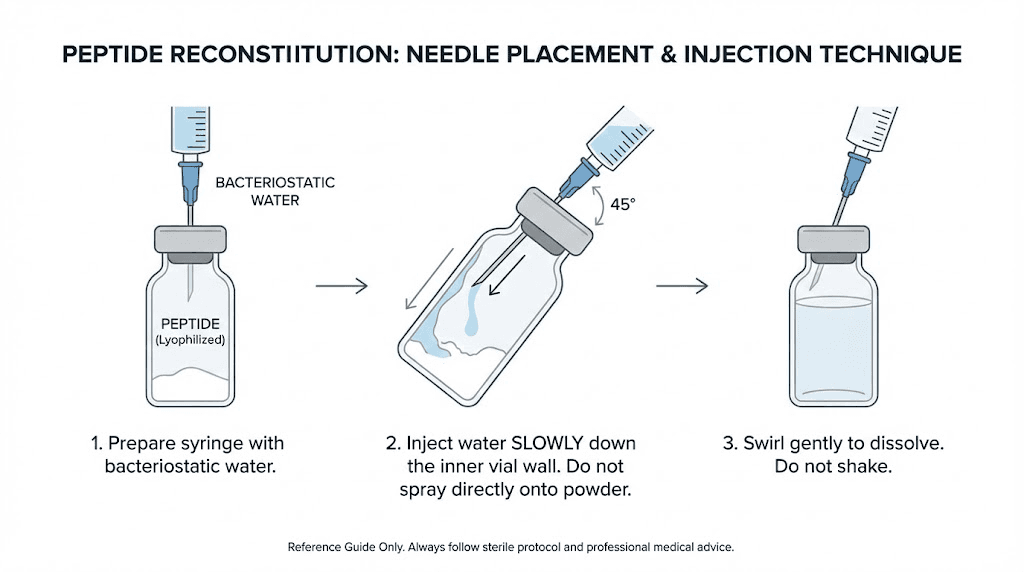
Swab the peptide vial stopper. Insert the needle and direct the BAC water toward the inside wall of the vial rather than blasting directly onto the powder at full force. This helps the liquid wet the powder more evenly.
Technique tip: Keep the movement smooth and controlled. You’re trying to rehydrate, not create splashing or foaming.
Step 4: Allow time for full rehydration before mixing aggressively
After adding water, give the vial time to fully hydrate. In many of my reconstitution attempts, the “powder didn’t dissolve” issue wasn’t actually a problem—it was insufficient wetting time. I typically wait briefly, then reassess appearance.
Step 5: Mix by gentle swirling (not vigorous shaking)
Instead of shaking hard, use gentle swirling or slow rolling motions to dissolve the peptide. Stop once the solution looks uniform (no visible clumps or dry spots).
- Why this works: Many peptides rehydrate through surface wetting and gradual dissolution; gentle mixing supports that process without introducing excessive foaming.
- What I watch for: If clumps persist, I don’t keep “punching” it with harder shaking—I let it settle briefly and swirl again more gently.
Step 6: Inspect and label immediately
Check the solution visually for unusual cloudiness, particulate matter, or persistent undissolved material. Then label the vial with:
- Concentration (mg/mL)
- Date/time of reconstitution
- Initial volume used (optional but helpful)
Step 7: Storage and timing (follow your peptide guidance)
BAC water helps inhibit microbial growth, but it does not make the solution “forever stable.” Follow storage guidance provided for your specific peptide (temperature, light exposure, and expected use window). In my workflow, I treat the “use window” as a hard constraint, not a suggestion.
Troubleshooting: what to do when things look “off”
Even with good technique, you may run into common issues. Here’s how I handle them.
If the solution looks cloudy
- First check: Did you allow enough time for wetting and dissolution?
- Then try again gently: Swirl slowly and re-inspect.
- Stop if persistent: If it remains persistently cloudy with visible particles, don’t “force” it further—pause and reassess your process or consult the supplier’s guidance.
If there are visible clumps or dry powder
- Don’t immediately shake aggressively.
- Give it a short rest, then swirl gently again.
- Confirm your added volume wasn’t too low for full rehydration.
If you mismeasured volumes
- Concentration will be wrong from the moment the incorrect volume was added.
- Correcting concentration usually requires careful re-planning; it’s often easier to start over rather than guessing.
If sterility feels compromised
- If a non-sterile surface contact occurred with a needle/syringe tip, I treat that as a contamination risk.
- In practice, the most responsible move is to discard and reconstitute with clean technique rather than “hoping it’s fine.”
Common mistakes I’ve seen (and how to avoid them)
- Skipping math for concentration: People remember “how to mix” but forget “how much water.” I’ve seen entire batches prepared at the wrong strength because the volume calculation wasn’t double-checked.
- Rushing dissolution: Powder that isn’t fully wetted often looks like a failed mix, when it’s really just too soon.
- Vigorous shaking: Creates bubbles and can make appearance misleading.
- Inconsistent technique: Different injection angles, different needle depths, different handling times—small inconsistencies add up.
- Not labeling: Without concentration and reconstitution date, even a good vial becomes unusable for decision-making.
FAQ
How long should I mix peptides with bac water before they dissolve?
Give the powder time to fully wet first, then use gentle swirling until the solution looks uniform. If clumps persist after gentle mixing and sufficient time, stop and reassess—don’t compensate with aggressive shaking.
Can I use more bac water than the calculation to “make it easier”?
Yes technically, but it changes concentration. If you dilute beyond your intended mg/mL, your dosing volume will also change. In my workflow, I treat calculated volume as part of the dosing system—not a preference.
What should the solution look like after mixing?
Ideally it should look uniform with no visible undissolved particles. Minor appearance differences can occur depending on peptide characteristics, but persistent clumps, particles, or unusual haze are signals to pause and follow supplier guidance rather than continuing.
Conclusion: Your next step to mix peptides with confidence
To mix peptides with bac water reliably, focus on three things: correct volume math, gentle aseptic rehydration (time to wet first, then swirl), and immediate inspection plus accurate labeling. That combination is what turns a “guessing game” into a repeatable process.
Next practical step: Before you puncture any vials, write down your target concentration (mg/mL), calculate the BAC water volume, and set that volume with the syringe before you begin mixing. This one move prevents the most common dosing errors.
Discussion