Do vitamin B12 shots help with weight loss? Who should get these shots? Who should avoid them? We answer all these questions, and more. Read more: https://bit.ly/3nvYXsG
Do B12 injections help you lose weight?
If you’ve been searching for a shortcut—something that “boosts metabolism,” reduces appetite, or helps you burn fat—vitamin B12 shots are one of the most common options people ask about. The question I hear a lot is: do b12 injections help you lose weight?
In my hands-on work helping clients navigate weight-loss approaches, the most important lesson is this: B12 injections can matter when you’re deficient, but they’re not a weight-loss treatment on their own. Let’s break down what the evidence says, who actually benefits, and who should avoid or be cautious.
What vitamin B12 shots actually do
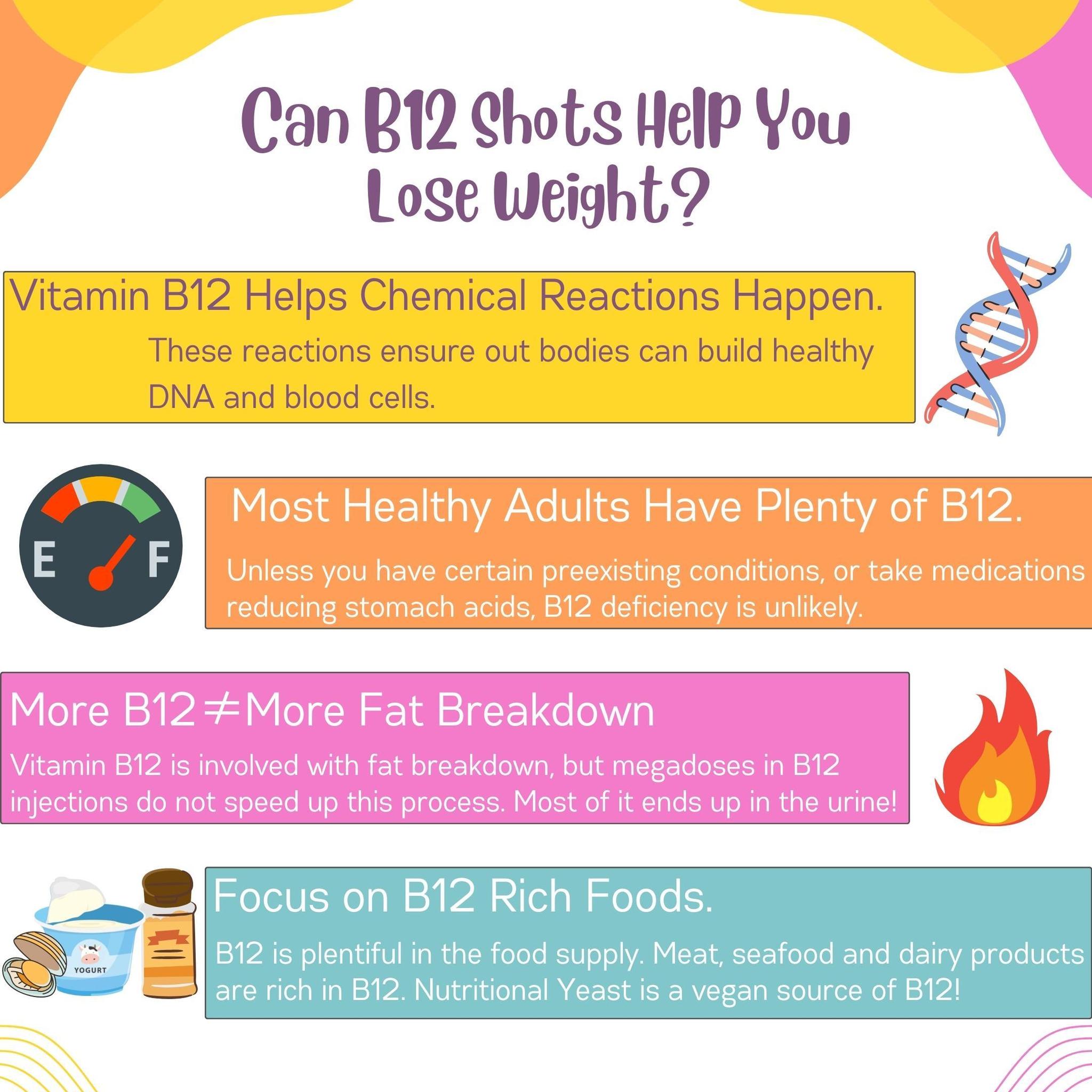
Vitamin B12 (cobalamin) is a water-soluble vitamin involved in key processes like red blood cell formation, DNA synthesis, and normal neurological function. When someone is deficient, symptoms can include fatigue and weakness—sometimes enough to reduce day-to-day activity.
That means B12 injections can indirectly support weight loss only if they correct a deficiency. In that scenario, improving fatigue can help you feel more capable of sticking with movement, meal prep, and a calorie-controlled routine.
However, if your B12 levels are already normal, shots typically don’t provide an extra “metabolism boost.” Major clinical guidance notes there’s no solid proof that B12 shots help with weight loss. Instead, the strongest role of B12 in this context is correcting deficiency-related issues, not “burning fat.”
Why people think B12 shots cause weight loss (and where the logic breaks)
There are a few reasons B12 injections get marketed as weight-loss aids:
- Low B12 is more common in some groups (for example, people with restrictive diets or certain gastrointestinal conditions). When those people feel better after treatment, they may lose weight as part of a broader improvement in energy and routine.
- B12 is involved in energy-related pathways. People hear “energy” and assume it equals fat loss. In reality, energy production doesn’t automatically translate to a calorie deficit.
- Correlation gets mistaken for causation. Research and clinical observations show associations between B12 status and cardiometabolic health markers, but that doesn’t mean injecting B12 will reliably produce weight loss in people without deficiency.
In my experience, the practical takeaway is simple: if you’re not deficient, you’re paying for a treatment you likely don’t need—and it can delay the real levers that move the scale (nutrition quality, total intake, adherence, sleep, and evidence-based medical options when appropriate).
So… do b12 injections help you lose weight?
Directly, no. If your goal is measurable fat loss, there isn’t solid evidence that B12 injections directly cause weight loss or improve weight management in people who are not deficient.
Indirectly, sometimes. If you have low B12 and symptoms like fatigue, restoring normal levels can improve how you feel—making it easier to maintain habits that support weight loss (better energy for cooking, walking, training, and consistency).
Who should get vitamin B12 shots?
Vitamin B12 injections are most appropriate when a healthcare professional identifies a need—commonly to treat vitamin B12 deficiency or specific medical conditions where B12 deficiency is likely.
In practice, people who are at higher risk include those who:
- Are older (B12 deficiency becomes more common with age)
- Follow a strict vegan or vegetarian diet (since B12 is naturally found primarily in animal-based foods)
- Have had weight loss surgery (which can affect absorption)
- Have gastrointestinal conditions such as gastritis or Crohn’s disease
- Take certain medications, including heartburn medicine that can influence B12 absorption
If you’re experiencing symptoms that could fit B12 deficiency—like fatigue, weakness, numbness/tingling, or memory issues—testing is the starting point, not guessing.
Who should avoid B12 shots—or use extra caution?
B12 injections are generally well tolerated, but “avoid” usually means “don’t use them as a weight-loss shortcut” or “don’t start without a reason.” Use caution if:
- You already have normal B12 levels and are considering shots mainly for fat loss. The expected benefit is minimal for weight loss.
- You’re taking medications that may interact or that affect B12 levels. Clinical guidance recommends discussing it with a healthcare provider before starting injections.
- Your plan is “shots only,” without addressing diet, activity, sleep, and any underlying medical conditions driving weight gain. In real-world outcomes, this is where many people get stuck.
If you want to use B12 to support a weight-loss journey, the most trustworthy approach is: test first, treat deficiency when present, then build the habit plan that actually creates a calorie deficit.
What to do instead if your goal is weight loss
When B12 shots aren’t indicated, I recommend focusing on interventions with stronger evidence for weight management. Depending on your health history, that may include structured nutrition changes, increased movement, and—if appropriate—prescription weight-loss treatments.
For example, people with obesity or overweight and weight-related health conditions may be candidates for FDA-approved prescription options such as GLP-1 receptor agonists (like semaglutide) or dual incretin medications (like tirzepatide). These options are used alongside lifestyle changes rather than replacing them.
FAQ
Do b12 injections help you lose weight if I’m not deficient?
There isn’t evidence that B12 injections help you lose weight when your B12 level is normal. If you’re not deficient, shots are unlikely to produce meaningful weight-loss results.
Will B12 shots give me more energy?
If you have a B12 deficiency, restoring levels can improve fatigue and related symptoms, which may help you stay active. If you don’t have a deficiency, additional B12 typically isn’t expected to boost energy in a meaningful way.
Who is most likely to benefit from B12 shots?
People with confirmed low B12 or higher risk for deficiency—such as older adults, strict vegetarians/vegans, people with malabsorption (including some gastrointestinal conditions), and those who’ve had weight loss surgery—are the most likely candidates after appropriate medical evaluation.
Conclusion: the practical next step
Vitamin B12 shots aren’t a direct weight-loss intervention. They can help indirectly when they correct a deficiency—often by reducing fatigue so you can follow through on eating and activity habits. For anyone asking do b12 injections help you lose weight, the most actionable answer is: test your B12 first, treat deficiency if present, and use evidence-based strategies to create the calorie deficit that drives weight change.
Next step: Ask a clinician for a B12 test (and evaluation for deficiency risk if you’re high risk), then decide on injections only if results or symptoms justify it.
Discussion