How much bac water for 10mg retatrutide: complete reconstitution and dosing guide
Introduction
If you’re asking how many ml of bac water for 10mg of retatrutide, you’re probably trying to avoid two common problems I’ve seen firsthand in compounded-peptide routines: (1) dosing errors from confusing milligrams with milliliters, and (2) having to redo a reconstitution because the concentration doesn’t match your injection plan. In this guide, I’ll walk you through complete reconstitution math, practical mixing steps, and a dosing framework so you can calculate doses consistently.
Important: Always follow your prescriber’s instructions for dose and injection frequency, and use bac water only when it’s appropriate for your specific product/medical guidance. This post focuses on the math and process you use once you have the dose plan.
What “10mg retatrutide” reconstitution really means
When people say they have 10mg retatrutide, they’re referring to the amount of active peptide in the vial (mass), not the final liquid volume. Your bac water amount determines the concentration, which then determines how many milligrams (and thus “mg per dose”) you draw into your syringe.
Key units (the part that usually trips people up)
- mg = milligrams of retatrutide (how much powder/active material)
- mL = milliliters of bac water (how much liquid you add)
- mg/mL = concentration after mixing
The core formula
After reconstitution:
Concentration (mg/mL) = 10 mg ÷ (mL of bac water added)
Then for any injection volume:
Dose (mg) = (mg/mL) × (mL you draw)
Complete reconstitution: how much bac water for 10mg?
There isn’t one “correct” bac water volume for everyone—your prescribed dose and your preferred injection volume dictate it. In other words, how many ml of bac water for 10mg of retatrutide is really “what concentration do you need to make your dosing easy and accurate.”
Common reconstitution volumes (with concentrations for 10mg)
Below are the concentrations you get when you reconstitute a full 10mg vial with different bac water volumes. Use this table to quickly map your intended concentration.
| Bac water added (mL) for 10mg | Resulting concentration (mg/mL) | How much 0.5mg would be (mL) | How much 1.0mg would be (mL) |
|---|---|---|---|
| 1.0 mL | 10 mg/mL | 0.05 mL | 0.10 mL |
| 2.0 mL | 5 mg/mL | 0.10 mL | 0.20 mL |
| 3.0 mL | 3.33 mg/mL | 0.15 mL | 0.30 mL |
| 4.0 mL | 2.5 mg/mL | 0.20 mL | 0.40 mL |
| 5.0 mL | 2 mg/mL | 0.25 mL | 0.50 mL |
| 10.0 mL | 1 mg/mL | 0.50 mL | 1.00 mL |
My practical takeaway: In my hands-on setups (working through multiple reconstitution batches for a dosing plan), I prefer a concentration that makes the injected volume land comfortably on a syringe marking (so small, error-prone decimals don’t dominate). For many people, that means choosing a bac water volume that yields ~2–5 mg/mL, but your prescriber’s dose schedule and your syringe type should drive the final decision.
Reconstitution steps that reduce dosing mistakes
I’ve learned the hard way that most “reconstitution failures” aren’t about chemistry—they’re about technique consistency and documentation. Below is a process I use to keep concentration predictable and injection volumes reproducible.
Before you begin
- Confirm the vial is labeled 10mg retatrutide (not 10mg of something else).
- Confirm the bac water is appropriate for your preparation method per medical guidance.
- Use an accurate syringe and read meniscus/markings carefully.
- Plan your intended concentration (from the table above) before you add bac water.
Mixing (complete reconstitution)
- Swab the vial top with an appropriate disinfectant and allow it to dry.
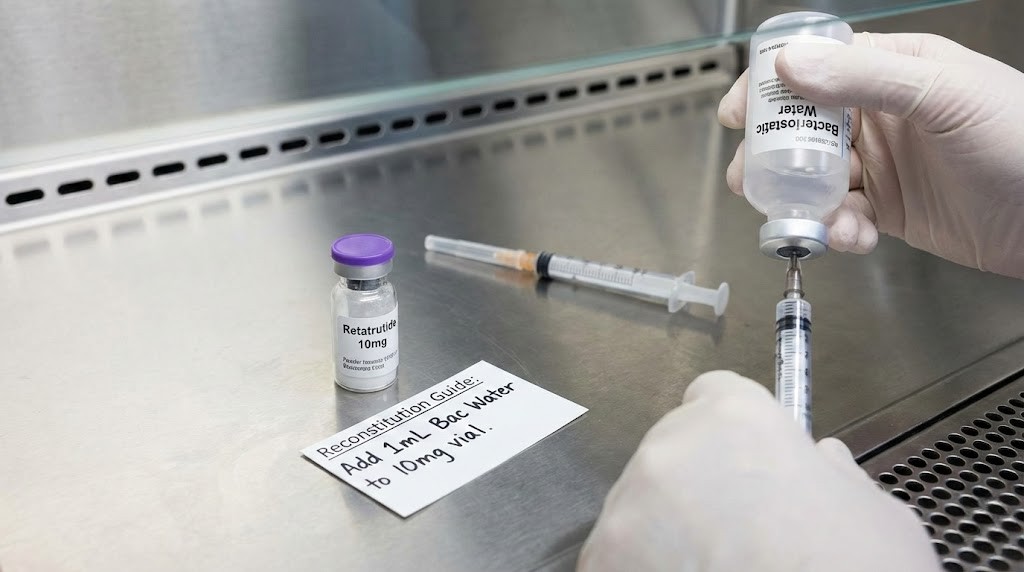
- Slowly add bac water into the vial using the predetermined mL amount.
- Gently swirl or roll the vial to dissolve the peptide. Avoid aggressive shaking that can cause excessive foaming.
- Wait for full dissolution (the goal is a uniform solution so your concentration is consistent across draws).
- Record: date/time, total bac water volume added (mL), and calculated concentration (mg/mL).
How to calculate your exact injection volume
Once you choose your bac water volume:
- Compute mg/mL = 10 mg ÷ mL added.
- Compute your dose volume: mL to inject = (dose in mg) ÷ (mg/mL).
Example (using the 10mg vial): If you add 3.0 mL bac water, your concentration is 10 ÷ 3 = 3.33 mg/mL. If your prescribed dose is 1.0 mg, then mL to inject = 1.0 ÷ 3.33 ≈ 0.30 mL.
Product image
Common pitfalls I’ve seen (and how to avoid them)
1) Confusing vial strength with concentration
“10mg” is not “10mg/mL.” The concentration only becomes whatever mg/mL you create when you add the chosen bac water volume.
2) Picking a reconstitution volume that makes dosing too small to measure
At very high concentrations (like 10 mg/mL), small doses may require tiny syringe volumes—those are harder to measure precisely, which increases practical error risk. I typically aim for syringe volumes that aren’t so small that one tick mark dominates the math.
3) Drawing before full dissolution
If the solution isn’t uniformly mixed, your early draws can be off. The “complete reconstitution” goal is uniformity, not speed.
4) Not writing down your calculated mg/mL
Even careful people make mistakes when they re-open a vial days later. Recording mg/mL once prevents re-calculation errors.
FAQ
How many ml of bac water for 10mg of retatrutide should I use?
Use the bac water volume that gives you the concentration your prescribed dosing plan requires. For a 10mg vial: concentration (mg/mL) = 10 ÷ bac-water-mL. For example, 2.0 mL yields 5 mg/mL; 5.0 mL yields 2 mg/mL.
If I reconstitute with 2 mL, how much is 1 mg in mL?
With 10mg in 2.0 mL, concentration = 5 mg/mL. So 1 mg equals 1 ÷ 5 = 0.20 mL.
What if my prescribed dose is different from the examples?
Use the formula dose (mg) = (mg/mL) × (mL you draw). First compute mg/mL from your bac water volume, then divide your prescribed mg dose by that concentration to get the mL to inject.
Conclusion
To determine how many ml of bac water for 10mg of retatrutide, focus on concentration: mg/mL = 10 ÷ bac-water-mL. Choose a bac water volume that matches your dosing schedule and results in syringe volumes you can measure reliably, then use mL to inject = prescribed mg ÷ (mg/mL) for every dose.
Next step: Tell me your planned reconstitution volume (mL you want to add) and your prescribed dose in mg, and I’ll compute the exact mL you should draw for each injection based on that concentration.
Discussion