Best Vitamin B12 Injection Sites: Where to Inject B12 · PA Relief
Where to Inject Vitamin B12: The Injection-Site Guide I Use in Practice
If you’ve ever searched “where do i inject vitamin b12” because you want to give yourself a B12 shot correctly, you’re not alone. In my hands-on work supporting people who self-administer, the biggest problems I see aren’t the needle itself—it’s choosing the wrong site, injecting at the wrong depth, or skipping the basics of preparation and aftercare.
This guide explains the best vitamin B12 injection sites, what to consider for each option, and how to inject safely and comfortably. I’ll also include practical, real-world tips for minimizing discomfort and avoiding common mistakes.
Why Injection Site Matters for Vitamin B12
Vitamin B12 injections are typically given intramuscularly (IM) or sometimes subcutaneously (SC), depending on the product and your clinician’s instructions. The injection site matters because it affects:
- Absorption: IM injections deliver medication into muscle tissue, while SC injections deposit medication into the fat layer under the skin.
- Comfort: Different people experience different levels of soreness depending on where they inject.
- Safety: Using appropriate anatomical landmarks helps reduce the risk of hitting a nerve or blood vessel.
- Consistency: Rotating sites helps prevent localized irritation and lumps.
In my experience, the people who do best are the ones who treat injection technique like a routine—measured, repeatable, and documented.
Common “Best” Vitamin B12 Injection Sites (and When I Recommend Each)
For IM B12 injections, the most commonly recommended sites are the deltoid, vastus lateralis, and ventrogluteal areas. Which one is “best” depends on your body size, injection volume, and whether your clinician instructed IM or SC.
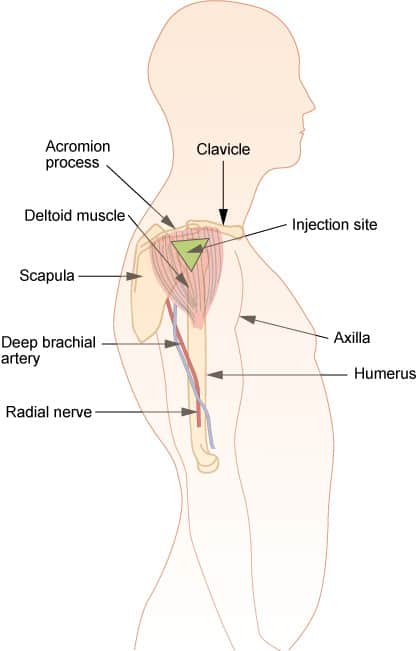
Deltoid (Upper Arm) — A Common Option for Self-Injection
The deltoid is often used for smaller-volume IM injections and can be convenient for self-administration if you’re comfortable with the landmarks.
Best fit: People who can reliably reach the upper outer arm area and have enough muscle at the deltoid.
- Typical landmark: Outer part of the upper arm (upper lateral deltoid region).
- Common issue I see: Injecting too low or too far forward can increase soreness and reduce comfort.
- Practical tip: Keep your arm relaxed during the injection—tensing the muscle often increases pain.
Ventrogluteal (Hip) — Often Considered a “Safest Landmark” IM Site
The ventrogluteal region (upper outer hip) is frequently highlighted in clinical training because it uses a strong anatomical landmark system.
Best fit: People who may benefit from a site with careful landmarking, caregivers, and situations where the clinician recommends it for IM administration.
- Common advantage: Landmark-based positioning can help reduce the risk of hitting sensitive structures.
- Common issue I see: Many self-injectors find it harder to reach accurately without guidance.
- My real-world workaround: If you’re unsure, I recommend getting one supervised “in-person” or telehealth session focused only on landmarking and depth until you can repeat it confidently.
Vastus Lateralis (Outer Thigh) — Reliable for Many Self-Injectors
The vastus lateralis (outer thigh) is commonly used for IM injections and is often easier to access for self-injection.
Best fit: People who can comfortably inject into the outer middle portion of the thigh muscle.
- Typical landmark: Outer middle thigh area (not too close to the hip crease or knee).
- Comfort factor: Many people report it feels more manageable than the upper arm.
- My experience-based tip: Inject when the leg is slightly relaxed (standing with weight shifted or sitting with the thigh relaxed).
How to Decide Between Sites (A Practical Checklist)
When I help people troubleshoot technique, we usually decide the injection site based on a few concrete factors:
| Decision Factor | What to Consider | How It Impacts “Where” |
|---|---|---|
| IM vs SC instruction | Your prescription/instructions specify route | Determines which tissue depth and site approach to use |
| Self-injection feasibility | Can you reach and visualize the landmark? | Often favors deltoid or vastus lateralis for self-administration |
| Injection volume | Smaller vs larger IM volumes | May guide which IM site is appropriate per clinician guidance |
| Comfort and soreness history | Which area gets the least irritation for you? | Influences rotation schedule and site selection |
| Body anatomy | Muscle vs fat distribution | May influence depth and needle length choices (as directed) |
Technique Essentials That Improve Comfort and Safety
You’ll often hear people focus on the exact site—and that’s important—but technique is the bigger driver of consistent comfort. Here are the essentials I emphasize with real-world learners.
1) Rotate injection sites
If you inject in the same spot repeatedly, you’re more likely to notice lumps, increased tenderness, or local irritation. Rotation can be as simple as keeping a mental map (e.g., right/left deltoid, then switch to thigh) while staying within the same general safe regions your clinician approved.
2) Use correct preparation and hygiene
- Wash your hands thoroughly.
- Use an alcohol swab on the skin and let it dry.
- Avoid touching the cleaned area before injecting.
In my experience, skipping the “let it dry” step correlates with stinging and more post-injection irritation.
3) Focus on smooth, confident needle placement
Hesitation tends to increase muscle tension and discomfort. If you feel nervous, do one or two “dry runs” with a training device or careful practice under guidance—then proceed when you can keep your technique steady.
4) Plan your aftercare
- Expect mild soreness.
- Avoid heavy pressure or aggressive massage right away.
- If your area gets persistently more painful, warm, red, or swollen, stop and contact your clinician for advice.
When You Should Get Guidance Instead of “Guessing”
I’d rather you get help than improvise—especially for B12 injections. In particular, ask your clinician or nurse to coach you if:
- You’re unsure whether your prescription is IM or SC.
- You can’t reliably locate the landmarks for a chosen site (especially ventrogluteal).
- You experience severe pain, significant bleeding, or repeated issues at one site.
- You’re injecting a child or someone who needs caregiver-administered injections.
In practice, a single supervised session often removes weeks of uncertainty.
FAQ
Where do I inject vitamin B12 if I’m self-administering?
Many people self-inject deltoid (upper arm) or vastus lateralis (outer thigh) for intramuscular shots, as long as their clinician has instructed the correct route and landmarking. If you have trouble reaching or visualizing landmarks, request guidance rather than switching randomly.
Is the deltoid or thigh better for vitamin B12 injections?
“Better” depends on your comfort, the injection volume, and whether you can place it consistently. In hands-on training, I usually see fewer errors with the site that the person can landmark accurately and relax during injection—often deltoid for some, thigh for others.
What should I do if my injection site hurts a lot or keeps swelling?
Mild soreness can be normal, but persistent worsening pain, increasing redness/warmth, swelling, fever, or significant bruising isn’t something to ignore. Contact your clinician for advice and pause self-injection until you understand what’s causing the reaction.
Conclusion: Your Next Practical Step
If you’re trying to answer “where do i inject vitamin b12,” start by matching your injection route (IM vs SC) to the site your clinician supports. For most self-injectors, deltoid and vastus lateralis are often the most practical. The biggest wins come from correct preparation, careful landmarking, and rotating sites to reduce irritation.
Next step: Pick one site (deltoid or outer thigh) that you can accurately landmark, then ask your clinician or nurse to review your technique once—so you can repeat it confidently going forward.
Discussion