what's the difference between bac water and sterile water Bacteriostatic Water vs Reconstitution Solution Guide
Introduction
If you’ve ever stood in front of a drawer of vials and wondered bac vs sterile water—which one is safe for reconstitution, and which one could complicate your dosing—you’re not alone. In my hands-on work with clinical supply workflows and compounding support, I’ve seen the same confusion lead to delays, wasted vials, and unnecessary re-testing. This guide explains the real-world differences between bacteriostatic (bac) water and sterile water for injection, how “bacteriostatic” actually changes what the water does, and how to choose the right option for reconstitution.
Bac Water vs Sterile Water: What They Are (and Why It Matters)
Both products are commonly used to reconstitute medications that are supplied as powders or lyophilized forms. The key difference is what’s happening at the microbial level.
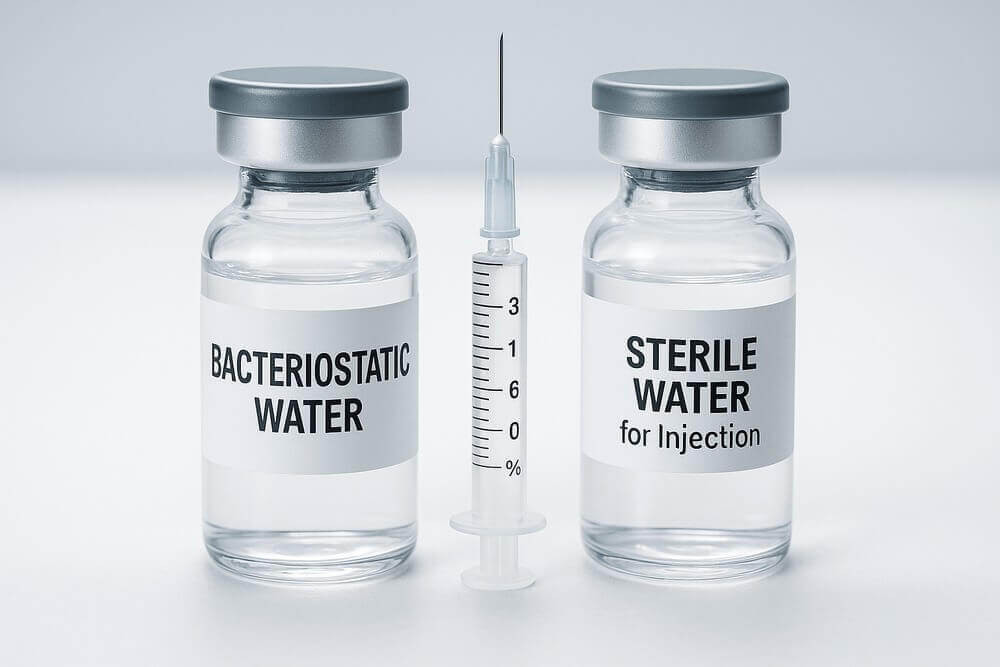
Bacteriostatic (Bac) Water
Bacteriostatic water is sterile water plus a bacteriostatic agent (commonly benzyl alcohol in many pharmacy and clinical settings). “Bacteriostatic” means it inhibits bacterial growth, not that it sterilizes or kills all microorganisms instantly.
In practical terms, bac water is often used when a medication needs to be reconstituted and then used over multiple administrations—because the bacteriostatic component can reduce the risk of microbial proliferation if the vial is accessed multiple times (assuming proper technique and storage).
Sterile Water (for Injection)
Sterile water is water that has been sterilized and is intended to be free of viable microorganisms. When sterile water is used to reconstitute a medication, the resulting solution’s microbial risk is managed primarily by the medication formulation and your handling—not by an added bacteriostatic agent.
Many sterile-water reconstitution practices focus on minimizing vial punctures and using the prepared solution per the medication’s storage/administration guidance.
The Core Difference: How Bac Water Changes Microbial Risk
Here’s the underlying logic I rely on when deciding “bac vs sterile water” in real workflows:
- Bac water adds an agent that helps suppress bacterial growth, which can be useful when the reconstituted product is accessed more than once.
- Sterile water does not add a microbial growth inhibitor, so the safest approach typically emphasizes single-use handling or strict adherence to the medication’s recommended handling and storage limits.
In my experience, the biggest mistake isn’t misunderstanding the label—it’s assuming that “bacteriostatic” makes everything indefinitely safe. It doesn’t. If technique is poor (contamination during needle entry, leaving vials unsealed, incorrect temperatures), the bacteriostatic effect isn’t a substitute for sterile procedure.
Reconstitution Scenarios: When Each One Is Usually Used
Both bac water and sterile water can be used for reconstitution, but the “right” choice depends on the medication’s instructions and how you plan to store and access the reconstituted solution.
Common reasons bac water is selected
- Multi-dose access: The reconstituted product may be used over a period that involves multiple vial punctures.
- Workflow convenience: In busy settings, bac water can reduce the practical risk profile when proper technique is consistently used.
Common reasons sterile water is selected
- Single access or single-dose use: If you’re preparing for an administration window that doesn’t require repeated needle entries, sterile water can be appropriate.
- Medication-specific requirements: Some product instructions are written with sterile-water reconstitution assumptions.
Key point: Always follow the reconstituted medication’s prescribing information or pharmacist instructions. In many cases, the product insert will specify the appropriate diluent and any limits on storage time after reconstitution.
Practical “Do/Don’t” Checklist (What I’d Do in Real Life)
When you’re comparing bac vs sterile water, use this as a practical decision checklist. This mirrors the steps I’ve used in inventory and reconstitution training sessions to reduce errors.
Do
- Confirm the diluent required by the specific medication you’re reconstituting.
- Use aseptic technique every time you access the vial (clean surfaces, correct needle/syringe, minimal punctures).
- Label the reconstituted vial with date/time and any handling notes from the medication insert.
- Follow storage limits after reconstitution (temperature and time windows vary by product).
Don’t
- Don’t assume bacteriostatic equals indefinite safety. Contamination risk can still rise if technique or storage is off.
- Don’t “swap” diluents based solely on convenience—especially if the medication insert specifies a particular diluent type.
- Don’t ignore expiration dates on the diluent and the reconstituted solution.
Which One Should You Choose? (A Clear Decision Framework)
When you need an answer quickly, I recommend this decision framework:
| Decision Factor | Bac Water Tends to Fit When… | Sterile Water Tends to Fit When… |
|---|---|---|
| Medication instructions | The product is intended to be reconstituted using a bacteriostatic diluent | The product specifies sterile water (or your pharmacist instructs sterile only) |
| Planned vial access | Multiple administrations may require repeated access of the reconstituted vial | Single access / minimal punctures are expected |
| Storage/handling expectations | The reconstituted solution’s handling window aligns with multi-access use (per product guidance) | You will follow strict single-dose or limited-use handling windows |
| Error reduction in workflow | You can maintain aseptic technique and need a microbial risk buffer for multi-access scenarios | You minimize punctures and adhere closely to product-specific handling limits |
FAQ
Is bac water the same as sterile water?
No. Bac water is sterile water plus a bacteriostatic agent designed to inhibit bacterial growth. Sterile water is sterilized water without that added bacteriostatic component.
Can I use bac water for any medication that needs reconstitution?
Don’t assume so. The correct diluent is medication-specific. Always follow the prescribing information or pharmacist instructions for the exact product you’re reconstituting.
Does bacteriostatic water make reconstituted medicine “safer” indefinitely?
It can reduce bacterial growth compared with diluent-free handling, but it doesn’t eliminate contamination risk or extend beyond the medication’s stated storage/handling time limits. Technique, storage conditions, and product guidance still control safety.
Conclusion
The practical difference between bac vs sterile water comes down to microbial risk management: bac water adds a bacteriostatic agent that helps inhibit bacterial growth during multi-access scenarios, while sterile water relies on sterile preparation, aseptic technique, and strict adherence to the medication’s reconstitution and storage guidance.
Next step: Take the medication name and reconstitution instructions you’re using, and match the required diluent type (bac vs sterile) exactly—then label and store the reconstituted solution according to the product’s specified limits.
Discussion