Best Vitamin B12 Injection Sites: Where to Inject B12 · PA Relief
Introduction
If you’re planning b12 self injection sites, the hardest part isn’t the needle—it’s choosing a site that’s safe, convenient, and consistent enough to help you stick with treatment. I’ve helped patients and caregivers through real-world injection routines where time, body habit changes, and injection anxiety all matter. In this guide, I’ll walk you through the best vitamin B12 injection sites, what “good technique” looks like, and how to reduce common issues like soreness, bruising, and missed doses. We’ll also cover how site choice differs for intramuscular (IM) versus subcutaneous (SC) B12 injections.
Why Injection Site Choice Matters for Vitamin B12
Vitamin B12 injections are typically given to deliver the medication reliably when oral therapy isn’t suitable (for example, significant malabsorption, severe deficiency, neurologic symptoms, or poor response to tablets). The injection site matters because it affects:
- Medication absorption: IM injections generally place medication into muscle tissue, while SC injections place medication into the fatty tissue layer.
- Tissue trauma: Some areas tolerate repeated injections better than others, especially if you inject frequently.
In my hands-on work, patients who found a reliable site (and a repeatable routine) were far more likely to complete their schedule without skipping doses.
Important: Injection technique and site selection depend on whether your prescribed B12 is meant to be injected IM or SC. Always follow your clinician’s instructions and the product label for route and dose.
The Best Vitamin B12 Injection Sites (IM and SC)
Below are the commonly used sites for B12 injections, with practical guidance on when each tends to be used. In clinical practice, B12 is often administered IM. However, some regimens and formulations may be appropriate for SC—your prescriber’s route guidance is the deciding factor.
1) Deltoid (IM): A Common Self-Injection Option
The deltoid is a frequently recommended IM site because it’s accessible and easy to visualize with proper landmarking. It’s also the site shown in many training materials.
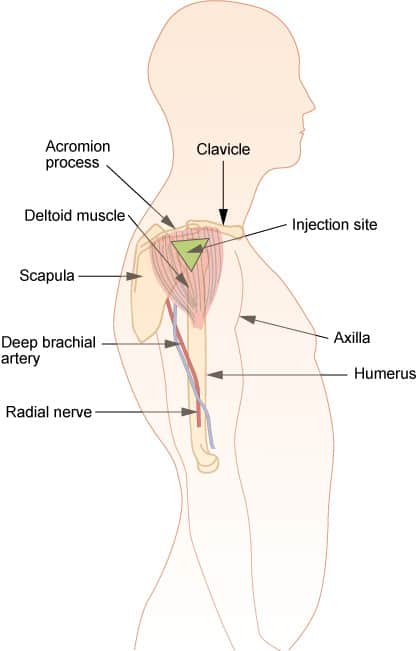
How I think about deltoid injections in real life: Deltoid injections can work well when you can reach your own upper arm reliably and you have enough muscle to target. When people have very low body fat or limited shoulder muscle, deltoid injections can feel more uncomfortable or less consistent, and we may choose another site.
Key points:
- Use the deltoid muscle area (upper outer arm) rather than the shoulder joint itself.
- Rotate injection locations within the deltoid to reduce local irritation.
- If you experience repeated soreness that interferes with daily function, consider discussing alternate IM sites with your clinician.
2) Vastus Lateralis (Thigh, IM): My Go-To for Comfort and Repetition
The vastus lateralis (outer middle portion of the thigh) is often a top choice for b12 self injection sites when people need a site they can use consistently. Many self-injectors can access their thigh more easily than the upper arm.
Why I like this site operationally: In my experience, thigh injections are easier to maintain on schedule. People can lie down, stand, or sit comfortably, and the landmarks are straightforward. When adherence is the goal, this matters.
Key points:
- Target the outer mid-thigh area (not the front knee area and not too close to the groin).
- Because thigh muscle is generally well-developed, this site can be comfortable for repeated dosing.
- Rotate left/right thigh and vary the exact spot within the recommended zone.
3) Ventrogluteal (Hip, IM): Often Preferred for Safety, But Technique Matters
Ventrogluteal IM injections are commonly described as a “safety-preferred” hip site because the anatomy reduces the chance of hitting major nerves or blood vessels when done correctly. However, many patients prefer a clinic-assisted approach initially due to landmarking complexity.
Key points:
- Use clinician-style landmarks—don’t guess.
- Great option once you’ve been trained, especially if you want an IM site with strong anatomic rationale.
- If you can’t confidently locate the landmark, choose a site you can identify accurately (like thigh) until you receive hands-on coaching.
4) Subcutaneous Sites (SC): When Route Allows Fatty Tissue Delivery
Some B12 preparations or regimens may be administered subcutaneously. SC injection sites generally target subcutaneous fat rather than muscle. Common SC sites include the abdomen (avoiding the navel area) and certain outer thigh regions.
How to choose responsibly: Many “where to inject” guides blur IM and SC. That’s a mistake I’ve seen lead to more soreness and inconsistent comfort. If your prescription specifies SC, follow your clinician’s landmarks for the SC zone.
Key points (SC):
- Avoid injection into scars, irritated skin, or areas with lumps.
- Keep a consistent rotation pattern to prevent repeated local irritation.
- If you’re unsure whether your specific B12 is meant for IM or SC, stop and clarify with your healthcare provider before injecting.
How to Rotate Injection Sites (So You Don’t Overuse One Area)
Rotation isn’t just a hygiene preference—it’s a practical strategy to reduce recurring pain and bruising. I recommend treating site rotation like a schedule: you know where you injected last time, and you have a next-place plan.
| Injection Route | Example Site Rotation Pattern | Why It Helps |
|---|---|---|
| IM Deltoid | Left deltoid this dose → right deltoid next dose → alternate within the upper outer arm zone | Reduces repeated tissue trauma in one exact spot |
| IM Thigh (Vastus Lateralis) | Right thigh → left thigh → shift slightly within the outer mid-thigh landmark zone | Improves comfort and consistency over frequent dosing |
| IM Ventrogluteal | Left hip → right hip → maintain correct landmark each time | Targets safe anatomy when landmarking is accurate |
| SC (If prescribed) | Abdomen quadrant rotation or outer thigh rotation; avoid scar/irritated areas | Prevents local lumps and irritation patterns |
My practical rule: If you feel a spot that’s tender or bruised from the last dose, don’t reuse that exact area. Rotate to a fresh adjacent zone and reassess the next time.
Technique Basics That Reduce Pain and Complications
Even with the right b12 self injection sites, technique influences comfort and safety. Here are experience-based principles that I’ve seen make injections easier for patients.
Landmarks first, speed second
Most injection problems come from incorrect positioning rather than slow injection. Use a consistent landmarking approach every dose.
Skin preparation and cleanliness
Follow your clinician’s instructions for cleaning the injection site. Let the skin dry before injecting to reduce stinging.
Needle angle and depth (route-specific)
IM versus SC affects needle angle and target tissue depth. Your prescribing instructions and training should match your route and needle type. If you’re unsure, get hands-on training—guessing here is not worth it.
What “normal” discomfort looks like
- Some soreness for a day or two can be expected after IM or SC injections.
- Persistent or worsening pain, spreading redness, heat, fever, or drainage is not routine—contact your clinician.
- Large bruising can happen, especially if you move too much during injection; it should improve over time.
Common Questions About B12 Self Injections
FAQ
Which of the b12 self injection sites is easiest to do alone?
For many people, the thigh (vastus lateralis) is the most practical for self-injection because the landmarking is straightforward and the position is easy to access. If your route is IM and you’re trained, the deltoid can also be workable for self-injection, especially if your shoulder muscle is accessible.
Can I switch injection sites if one hurts?
Yes—site rotation is usually recommended, and switching between left/right and neighboring zones can help. If you consistently have significant pain or skin reactions, discuss alternate routes/sites with your clinician rather than repeatedly injecting into the same problematic area.
How do I know if my B12 is meant for IM or SC?
Your prescription and medication label should specify the route (intramuscular vs subcutaneous). I recommend aligning injection technique (site, angle, and depth) with that instruction. If the route isn’t clear, clarify with your healthcare provider before injecting.
Conclusion
Choosing the right vitamin B12 injection site comes down to matching your prescribed route (IM vs SC) with reliable landmarks you can repeat consistently. In my hands-on experience guiding patients, the best b12 self injection sites are the ones you can accurately locate, rotate smoothly, and tolerate well over time—often the thigh for self-sufficiency, with deltoid as another viable IM option when access and training are solid.
Next step: Confirm your B12 route (IM or SC) with your prescription instructions, then pick one site you can landmark confidently (commonly thigh for self-injection), and set a rotation plan for your dosing schedule.
Discussion