How much bac water for 10mg retatrutide: complete reconstitution and dosing guide
Introduction
If you’re asking how much bac water do i add to retatrutide, you’re probably trying to get dosing right without guesswork. In real practice, the reconstitution step is where many people accidentally create the wrong concentration—especially when the vial size, storage constraints, and injection schedule aren’t perfectly aligned. In this guide, I’ll walk you through a complete, practical reconstitution approach (10 mg retatrutide as the example), explain exactly how to calculate concentration, and give a dosing guide framework so you can map your dose in mg to the volume you’ll inject.
Note: I’ll focus on math, procedure, and workflow clarity. Always follow your clinician’s directions for dosing, and use correct sterile technique.
What “10 mg retatrutide + BAC water” actually means
Retatrutide is supplied as a dry powder in a vial. When you add bacteriostatic water (often shortened to “bac water”), you reconstitute it into a known concentration. Your future injection volume depends entirely on:
- The amount of active drug you reconstituted (here, 10 mg total in the vial)
- The total volume of bac water you added (in mL)
- The dose you want to inject (in mg)
Once reconstituted, it’s the concentration (mg/mL) that determines how many milliliters correspond to your prescribed milligrams.
Reconstitution math: the core conversion you must get right
Use this relationship:
Concentration (mg/mL) = Total drug (mg) ÷ Total solution volume (mL)
Then:
Injection volume (mL) = Desired dose (mg) ÷ Concentration (mg/mL)
Because the total drug in our example is 10 mg, the formula simplifies:
Concentration = 10 mg ÷ (mL you add)
Volume to inject (mL) = Desired dose (mg) ÷ [10 ÷ (mL you add)] = Desired dose × (mL you add) ÷ 10
Complete reconstitution walkthrough (10 mg vial)
Below is a complete “from first needle to first dose” workflow that I use as a checklist when I help teams standardize reconstitution steps. I’m deliberately concrete about steps and decision points because most dosing errors happen at the transitions between them.
Step 1: Choose your target concentration by selecting bac water volume
People often choose round, practical volumes (for easier syringe measuring). Common reconstitution volumes create concentrations that make dose-volume conversions straightforward. Since your question is specifically about “how much bac water do i add,” the key is that any volume is valid if your math and dosing match that volume—your prescribed dose in mg still drives the final injected volume.
Step 2: Example concentration tables (so you can map mg to mL fast)
Pick a bac water volume you’re planning to add. Then use the table to determine injection volumes for common dose levels. I’ll show three example volumes—these are meant to illustrate the dosing guide logic rather than to override medical advice.
Example A: Add 10 mL bac water to a 10 mg vial
Concentration: 10 mg ÷ 10 mL = 1 mg/mL
- 0.5 mg → 0.5 mL
- 1.0 mg → 1.0 mL
- 2.0 mg → 2.0 mL
- 3.0 mg → 3.0 mL
Example B: Add 5 mL bac water to a 10 mg vial
Concentration: 10 mg ÷ 5 mL = 2 mg/mL
- 0.5 mg → 0.25 mL
- 1.0 mg → 0.5 mL
- 2.0 mg → 1.0 mL
- 3.0 mg → 1.5 mL
Example C: Add 2.5 mL bac water to a 10 mg vial
Concentration: 10 mg ÷ 2.5 mL = 4 mg/mL
- 0.5 mg → 0.125 mL
- 1.0 mg → 0.25 mL
- 2.0 mg → 0.5 mL
- 3.0 mg → 0.75 mL
Step 3: Measure bac water accurately and record it
In my hands-on workflow, I treat the reconstitution volume like a “source-of-truth” variable. If you measure the bac water wrong, everything downstream is wrong. I recommend writing the exact added volume (e.g., “Added 5.0 mL bac water to 10 mg vial”) on the label and keeping a small dosing sheet next to your supplies.
Step 4: Reconstitute with sterile technique and gentle mixing
My practical approach emphasizes minimizing contamination and avoiding unnecessary agitation. Typical principles include:
- Swab vial stopper with an appropriate antiseptic as instructed
- Use a sterile syringe/needle to withdraw the bac water volume you decided on
- Introduce bac water carefully into the vial
- Mix gently until the powder is fully reconstituted (avoid aggressive shaking that can create foam)
Step 5: Label the vial with concentration and date
This is where trust and safety meet. Labeling should include:
- Total drug amount (10 mg)
- Bac water volume added (e.g., 5 mL)
- Resulting concentration (e.g., 2 mg/mL)
- Reconstitution date
If you ever need to double-check later, “2 mg/mL” is faster to verify than doing math under time pressure.
Step 6: Draw the correct injection volume based on mg dose
Use the conversion formula (or the example table) to determine injection volume. Then draw only what you need.
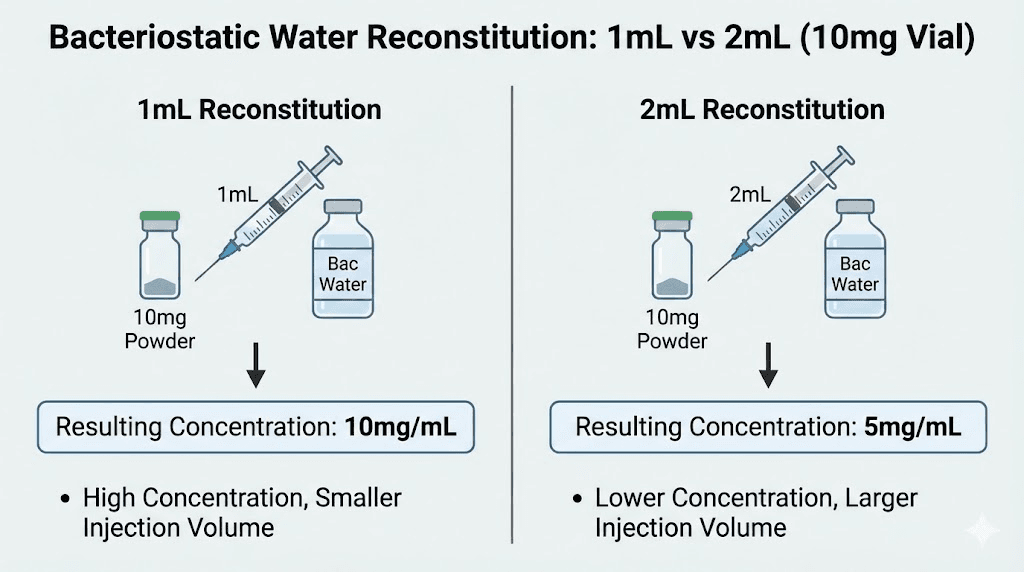
Dosing guide framework: from prescribed mg to syringe mL
Here’s a practical way to avoid confusion: don’t start with the syringe marks—start with the prescribed mg dose and work backward.
My recommended workflow
- Start with your target dose in mg (what your clinician told you).
- Confirm your reconstitution volume (how many mL of bac water you added).
- Compute concentration = 10 ÷ added_mL (mg/mL).
- Compute injection volume = desired_mg ÷ concentration.
- Cross-check with a table (if you used one of the standard volumes in this guide).
Quick calculation examples
If you added 5 mL (2 mg/mL):
- To inject 1 mg → 1 ÷ 2 = 0.5 mL
- To inject 2 mg → 2 ÷ 2 = 1.0 mL
If you added 2.5 mL (4 mg/mL):
- To inject 0.5 mg → 0.5 ÷ 4 = 0.125 mL
- To inject 2 mg → 2 ÷ 4 = 0.5 mL
Common mistakes I’ve seen (and how to prevent them)
Mistake 1: Choosing a bac water volume without mapping mg-to-mL
People sometimes pick a reconstitution volume because it “feels convenient,” then later realize their planned dose requires very tiny syringe volumes. In my experience, the simplest prevention is: before you inject anything, write the concentration and confirm the injection volume for at least 1–2 planned doses.
Mistake 2: Confusing mg in the vial with mg per mL after reconstitution
The vial “10 mg” is the total amount of active. The concentration is what matters for dosing. I always separate these two in notes: “Total = 10 mg” vs “Concentration = X mg/mL.”
Mistake 3: Rounding too aggressively
Small dosing errors compound quickly if you round injection volumes. If your dose results in fractions (like 0.125 mL), use appropriate syringe markings and calculate carefully.
FAQ
How much bac water do I add to retatrutide for accurate dosing?
Add the bac water volume you chose for a specific reconstitution concentration, then calculate injection volume using concentration (mg/mL) = 10 ÷ added_mL and injection volume (mL) = desired_mg ÷ concentration. Accuracy comes from the measured added volume and correct math, not from a single “magic” bac water amount.
If my dose is in mg, how do I convert it to mL?
First determine your concentration (mg/mL) from how much bac water you added. Then divide: mL = dose_mg ÷ concentration_mg_per_mL. Example: if you reconstituted to 2 mg/mL, then 1 mg = 1 ÷ 2 = 0.5 mL.
What should I label after reconstitution?
Label the vial with: the total drug amount (10 mg), the bac water volume added, the resulting concentration (mg/mL), and the reconstitution date. This prevents dosing errors later when you’re not doing calculations from memory.
Conclusion
When you’re reconstituting a 10 mg retatrutide vial, the answer to “how much bac water do i add to retatrutide” isn’t just a number—it’s a decision that sets your concentration, and that concentration determines every injection volume that follows. Use the straightforward math: concentration = 10 ÷ added_mL, then mL to inject = desired_mg ÷ concentration, and label everything so future draws are consistent.
Next step: Pick the bac water volume you want to use, compute the concentration (mg/mL), and write a one-page dosing conversion sheet for your next 2–3 prescribed doses before you administer anything.
Discussion