Best Vitamin B12 Injection Sites: Where to Inject B12 · PA Relief
Introduction
If you’re considering a vitamin B12 injection, the “where do I inject?” question is usually the first thing that makes people hesitate—especially when they’re doing it at home. In my hands-on work with patients managing B12 deficiency, I’ve seen the same pattern: incorrect injection site choice leads to more soreness, more bruising, and sometimes less confidence with the whole process. This guide walks you through the best place to inject vitamin b12 by comparing the most common injection sites, how to decide among them, and what technique details actually matter for comfort and consistency.
We’ll cover the major injection sites used for B12—especially intramuscular options like the vastus lateralis—and how to use practical criteria (muscle size, needle reach, comfort, and safety) to pick the right approach.
Before You Choose a Site: What “Good” Looks Like
Injection site selection isn’t about finding a “magic spot.” In practice, the best injection site is the one that reliably delivers the medication into the intended tissue with minimal complications for your body.
In my checklist, a good B12 injection site is...
- Muscle-based (for intramuscular injections): enough muscle bulk to reduce injection into fat
- Accessible for the person (or caregiver) giving the shot consistently
- Comfortable with your typical pain tolerance and prior bruising history
- Safe anatomy: avoiding areas where nerves/vessels are more likely to be at risk
- Repeatable: you can rotate sides and use a consistent landmark system
When those criteria align, injection technique tends to improve automatically—fewer “hesitation” moments, smoother delivery, and less variability between doses.
Best Vitamin B12 Injection Sites: Where to Inject B12
Most commonly, B12 injections prescribed for deficiency are given intramuscular (IM). IM sites are chosen to place the dose into muscle for more predictable absorption.
Below are the main IM injection sites I see in real-world home-care settings. I’ll also note when a site might be less ideal for someone, so you can choose with realistic expectations.
1) Vastus Lateralis (Outer Thigh) — Often a top “home” choice
The vastus lateralis is one of the most practical sites for home injections because it’s accessible and typically has enough muscle mass. In my experience, patients who struggle with self-injection find the thigh easier to locate and more comfortable once they learn the landmarks.
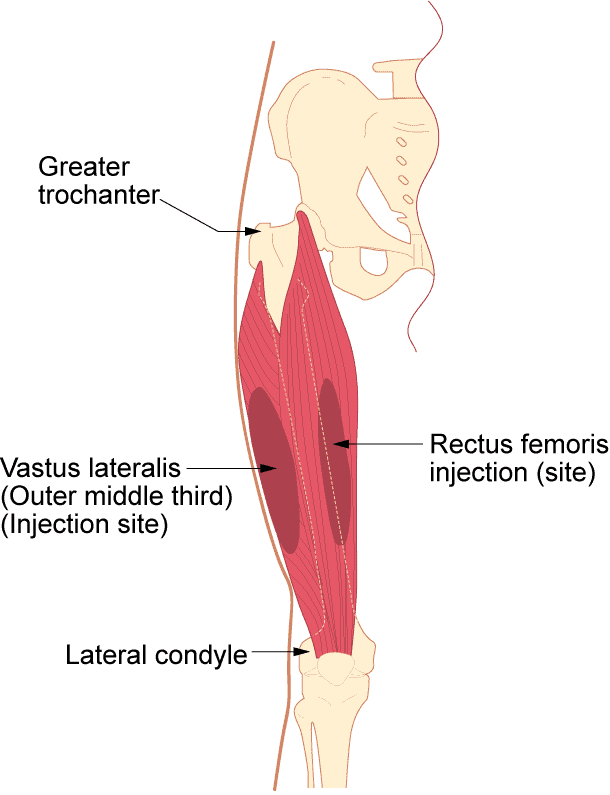
Why this site works: It provides a substantial muscle area, making it easier to aim the needle intramuscularly rather than into subcutaneous fat.
Practical limitations: If you have very low muscle mass or you’re unsure about needle length, you may feel more injection depth uncertainty—this is where clinician guidance matters. Also, if you recently had thigh injury, inflammation, or significant bruising, that’s a reason to choose another site and follow your prescriber’s advice.
2) Deltoid (Upper Arm) — Convenient, but depends on muscle size
The deltoid is commonly used for vaccinations and can be used for some IM injections. For B12, it can be a reasonable option when the deltoid has adequate muscle bulk.
Why this site works: It’s easy to access for someone injecting themselves or having help.
Practical limitations: Deltoid muscle size varies a lot. In smaller body types, there’s a greater chance of injecting too superficially into fat. If you’ve had frequent soreness or uncertain “depth,” deltoid may not be the best place for you—especially for consistent technique over repeated doses.
3) Ventrogluteal (Hip area) — Often favored for safety, but requires landmark confidence
The ventrogluteal region (front/side hip area) is widely discussed in clinical practice as a strong IM site because it helps aim for the muscle away from major nerves.
Why this site works: With correct landmarks, it can offer good protection from major anatomical structures.
Practical limitations: It’s not always the easiest site for self-injection unless you’re trained on landmarks. If you’re uncomfortable identifying the region reliably, accuracy drops—so technique training is a real requirement for this site to be “best” for your situation.
4) Dorsogluteal (Upper outer buttock) — Use depends on clinician preference and landmark accuracy
The dorsogluteal site (upper outer buttock) has been used historically for IM injections, but many clinicians prefer ventrogluteal for improved safety with landmarks. Whether dorsogluteal is appropriate depends on your prescriber’s instructions and your comfort with landmarking.
Why this site works: The buttock area typically contains muscle mass.
Practical limitations: If landmarking is uncertain, the risk profile changes. In my work, I’ve found that people who “eyeball” this site tend to report more discomfort because the injection isn’t consistently placed in the intended muscle zone.
How to Pick the Best Place to Inject Vitamin B12 for You
Instead of choosing based on internet recommendations alone, I suggest selecting the site that matches your anatomy and your ability to repeat the technique safely.
Use these decision factors
- Who is injecting? If it’s you at home, thigh (vastus lateralis) and deltoid are often the most feasible; caregiver support often makes ventrogluteal easier.
- Your body composition: If you have low muscle mass in the upper arm, thigh may be more reliable.
- Landmark confidence: If you can’t consistently identify the hip landmarks, don’t force ventrogluteal—choose a site you can locate accurately.
- Your comfort history: Track soreness/bruising by site for a few rounds; what hurts less and feels more consistent usually becomes the best place for you.
- Rotation plan: The “best” site is also the one you can rotate to reduce repeated trauma.
Injection Technique Details That Affect Comfort (Not Just the Site)
Site selection is important, but the small details are often what separate “easy” from “messy.” Here are the technique principles I emphasize in practical settings.
1) Rotate sites and track side-to-side
Repeated injections into the exact same spot can increase soreness and bruising. In my experience, a simple rotation approach (left thigh, right thigh, then alternate next dose, with a few centimeters of variation each time) improves comfort over the long term.
2) Use proper landmarking every time
If you use the thigh, keep the landmarks consistent. If you use deltoid, aim for the correct upper outer region of the arm. If you use ventrogluteal, confirm landmarks before injection.
3) Needle length and depth matter
Even the best injection site won’t perform well if the needle is inappropriate for your tissue depth. If you’re unsure whether the needle length matches your anatomy, ask your clinician for guidance before continuing.
4) Expect mild transient soreness, but don’t ignore red flags
Some tenderness is common after IM injections. However, if you develop worsening redness, heat, spreading swelling, persistent severe pain, fever, or drainage, you should seek medical evaluation rather than continuing injections through the same pattern.
Quick Comparison: Injection Sites for Vitamin B12
| Injection site | Common use for IM | Why it can be a “best” choice | Main limitation |
|---|---|---|---|
| Vastus lateralis (outer thigh) | Yes | Accessible; typically reliable muscle bulk for home use | Need landmark consistency and appropriate needle depth |
| Deltoid (upper arm) | Sometimes | Convenient for self-injection when deltoid is muscular enough | Smaller muscle mass can increase superficial placement risk |
| Ventrogluteal (hip area) | Yes | Often preferred for safety with correct landmarks | Landmarking can be hard without training |
| Dorsogluteal (upper outer buttock) | Historically; varies | Can have good muscle mass | Landmark accuracy is critical |
FAQ
What is the best place to inject vitamin B12 for home injections?
In many home-care situations, the vastus lateralis (outer thigh) is a top choice because it’s easier to access and often provides enough muscle bulk for intramuscular delivery. If you have a trained caregiver, ventrogluteal can also be a strong option. The “best” site is the one you can locate accurately and repeat safely.
Can I rotate between different B12 injection sites?
Often, yes—rotation is usually recommended to reduce local irritation. In practice, you should rotate within the same site category you were instructed on (e.g., alternating sides of the thigh, or using another approved IM site) and follow your prescriber’s guidance for your specific B12 product and dosing schedule.
When should I avoid a particular injection site?
Avoid using a site that’s actively inflamed, heavily bruised, infected, or significantly painful. If you notice persistent or worsening symptoms after injections, contact your clinician to reassess technique, needle length, and site choice.
Conclusion
The best place to inject vitamin B12 comes down to one practical goal: consistent intramuscular placement with minimal discomfort and reliable landmarking. For many people, vastus lateralis (outer thigh) is the most convenient, repeatable home option. Deltoid can work when the muscle is adequate, while ventrogluteal often offers strong safety advantages when landmark confidence is high.
Next step: Choose your injection site based on landmark accuracy and comfort (for most home users, start with the outer thigh), then create a simple rotation plan for the next few doses and track soreness/bruising by side so you can refine your “best” site with real feedback.
Discussion