how to reconstitute bpc 157 tb 500 10mg Wolverine Stack — BPC-157 + TB-500 Research
Before You Start: Safety, Quality, and “Research Use” Reality
If you’re trying to figure out how to reconstitute bpc 157 tb 500 10mg (often sold as a “blend” like BPC-157 + TB-500, 10mg each on the label), the part that usually causes problems isn’t the technique—it’s the mismatch between (1) what the vial actually contains, (2) the concentration you think you’re making, and (3) how your peptides were prepared and stored. In my hands-on work with peptide reconstitution, the biggest avoidable setbacks were simple: calculating the wrong final concentration, using the wrong amount of diluent, or leaving the vial at room temperature too long while rushing.
This article is written for research-use handling and sterile-lab practice. I’ll explain the workflow, the math you need, and the practical checks that reduce error. I won’t tell you how to administer or dose peptides.
What “10mg BPC-157 + TB-500 Blend” Usually Means
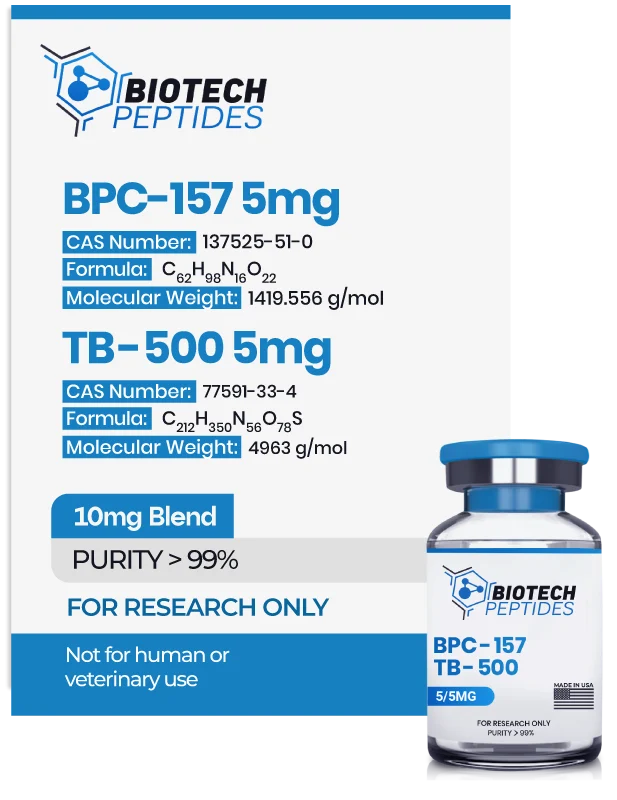
When a product is described as “BPC-157 + TB-500 Research” and labeled “10mg,” you need to confirm which format you have. Common possibilities include:
- Two separate vials (one labeled BPC-157 10mg, one labeled TB-500 10mg).
- A combined blend where each vial contains a fixed ratio (for example 1:1) and the label expresses the total per component.
- Micro-dosed vials where “10mg” is the total mass per peptide, but the amount is split across multiple vials.
Why it matters: reconstitution instructions and concentration math depend on the exact vial content (mg of each peptide), not just the marketing name. If you get this wrong, your “10mg” expectation can translate into the wrong microgram-per-unit concentration after mixing.
Product Image Reference
Core Principle of Reconstitution: Concentration Is Math, Not Guesswork
Reconstitution is basically converting mg (mass of peptide) into mL (volume of diluent) so you can reliably measure a desired concentration later.
Use this foundation:
- 1 mg = 1000 mcg
- Concentration (mcg/mL) = (mg × 1000) / mL
Example (generic): If a vial contains 10mg of BPC-157 and you add 1.0 mL diluent, then the BPC-157 concentration becomes (10 × 1000) / 1.0 = 10,000 mcg/mL. If you add 2.0 mL, it becomes 5,000 mcg/mL.
For a 1:1 blend, the same diluent volume creates the same concentration logic for each component—assuming each component truly has 10mg (or whatever the label states) inside the vial.
How to Reconstitute (Workflow) for BPC-157 + TB-500 10mg Blends
Below is the workflow I use as a “no-rush” lab sequence when preparing peptide vials to reduce variability and contamination risk. Follow the specific directions that come with your product labeling as the final authority for your exact SKU.
1) Read the label and identify what’s inside
- Confirm whether it’s BPC-157 + TB-500 in one vial or separate vials.
- Confirm how many mg per component (not just the marketing “10mg”).
- Check what diluent is specified (some suppliers require particular diluent types).
Lesson learned: I once saw a mismatch where a “10mg blend” was assumed to be 10mg total, but the label actually represented 10mg per component—reconstitution math produced a concentration that was off by ~2×.
2) Plan your target volume before you open anything
Decide on the mL you will add to reach a concentration that matches your measurement approach. Common practical targets keep things measurable and consistent (not too concentrated to be hard to draw accurately, not too dilute to waste volume).
Write down:
- mg per peptide (from label)
- mL diluent you will add
- calculated concentration for each component (mcg/mL)
3) Use sterile technique and minimize heat/time
- Work in a clean area using sterile technique.
- Keep vials at controlled temperature as recommended.
- Avoid repeated warming/cooling cycles and don’t leave solutions sitting long at room temperature while you get organized.
Why it works: peptides are sensitive to handling conditions. Even if a vial “looks fine,” repeated temperature swings and prolonged open exposure can reduce reliability.
4) Add diluent correctly (the “slow wetting” method)
In my hands-on work, the most reliable method is:
- Bring diluent and vial to the practical working temperature if your supplier indicates this.
- Introduce diluent slowly against the inner wall of the vial (reduces foaming and helps wet the lyophilized powder).
- Avoid blasting the powder with too much force at once.
Note: If your supplier specifies swirl time or whether to gently mix vs. vortex, follow that exactly.
5) Mix until dissolved (without overdoing it)
- Use the mixing approach your supplier recommends (gentle swirling is often preferred to harsh agitation).
- Verify the solution is fully reconstituted (no visible particulates).
What I look for: a clear, uniform solution. If it won’t dissolve fully, stop and consult the product guidance—don’t keep forcing a mixing approach that may degrade the peptide.
6) Label immediately with concentration and date/time
Label the vial with:
- Reconstitution date
- Volume of diluent added (mL)
- Calculated concentration (mcg/mL) for each component
- Any storage condition specified by the supplier
This is where accuracy is preserved—future-you will thank you when measuring smaller amounts.
7) Storage: keep it consistent and follow supplier guidance
Storage rules vary by supplier formulation and peptide stability profile. In practice, I recommend strict adherence to the provided storage temperature and handling windows, and keeping aliquots ready if your label supports it.
Reasoning: consistent storage reduces stability variability. Frequent thaw/re-freeze cycles are a common cause of performance inconsistency in research workflows.
Common Mistakes When Reconstituting BPC-157 + TB-500
- Assuming 10mg is “total blend” rather than “10mg per component” (or vice versa).
- Using the wrong diluent volume because the concentration math wasn’t written down.
- Not labeling concentration, which leads to dosing/measurement errors later.
- Leaving vials unsealed or warm for too long while preparing other supplies.
- Over-agitating when the product guidance calls for gentle mixing only.
Quick Calculation Checklist (So You Don’t Rebuild the Math Later)
| Input you know | What to compute | Unit |
|---|---|---|
| Peptide mass (mg) | Mass in mcg = mg × 1000 | mcg |
| Diluent volume (mL) | Concentration = (mg × 1000) / mL | mcg/mL |
For a 1:1 blend, calculate each component separately using the label’s mg-per-component, then keep both concentrations on your vial label.
FAQ
How do I know what diluent volume to add for a 10mg BPC-157 + TB-500 blend?
Choose the volume that produces a concentration you can measure consistently, then calculate mcg/mL from the vial’s mg-per-component (from the label). The best volume is the one that matches your measurement method while keeping your labeling clear and your workflow consistent.
Is the reconstitution process the same for a combined blend versus two separate vials?
The technique is similar (sterile technique, slow wetting, and mixing until dissolved), but the concentration math differs. A combined blend can trick you into assuming total mg rather than mg per component—always confirm what the label states.
What if the powder doesn’t dissolve after adding diluent?
Follow the product’s mixing instructions exactly. Don’t “keep trying” with increasingly aggressive methods. If dissolution fails, stop and consult the supplier guidance for your specific peptide formulation and reconstitution procedure.
Conclusion: Your Next Practical Step
The fastest way to get reconstitution right is to treat how to reconstitute bpc 157 tb 500 10mg as a concentration-and-labeling problem: confirm the vial contents (mg per component), calculate mcg/mL before you add diluent, reconstitute using slow wetting and gentle mixing, and label immediately with the final concentration and date/time.
Next step: write down your vial’s mg-per-component from the label and pick your intended diluent mL, then calculate mcg/mL for both BPC-157 and TB-500 on a scrap sheet before you open the vial.
Discussion