Bac Water To Peptide Ratio How much bacteriostatic water to add to peptides: complete mixing guide
If you’ve ever tried mixing peptides and ended up with cloudy solution, clumps, or inconsistent results, you already know the real problem: the bac water to peptide ratio is where most “mystery” issues start. In this guide, I’ll show you exactly how much bacteriostatic water to add to peptides for complete mixing—using practical steps I’ve followed in real compounding routines. I’ll also explain why the right ratio matters for dissolution, dosing accuracy, and repeatability.
Why the bac water to peptide ratio matters (beyond “just dissolving”)
When people talk about peptide reconstitution, they often focus only on whether the powder “disappears.” In my hands-on work, I learned that two additional factors matter just as much:
- Dosing consistency: If you don’t reconstitute to a predictable volume, your mg-per-mL becomes guesswork, and every later measurement compounds the error.
- Complete mixing behavior: Many peptides dissolve unevenly at first. A ratio that’s too low can create persistent micro-clumps; too high can change how easily the solution equilibrates (and can make later aliquoting harder).
The ratio is effectively your “target concentration plan.” Once you know the vial’s nominal peptide mass and the final volume you’re aiming for, the math becomes straightforward—then mixing technique determines whether the final concentration is actually uniform.
Reconstitution basics: what you need before you measure
Before mixing, I recommend you set up like you’re doing a lab workflow (because that’s what ensures repeatability):
- Peptide vial label (mg stated): Use the exact peptide mass listed by the supplier.
- Bacteriostatic water (BAC water): Confirm it’s appropriate for your use case as directed on your materials.
- Syringes/needles with clear gradations: If you’re targeting small volumes, fine markings reduce error.
- Alcohol wipes and clean surface: Minimize contamination and avoid touching vial stoppers.
- Timing discipline: Have a plan so the solution isn’t sitting while you hunt tools.
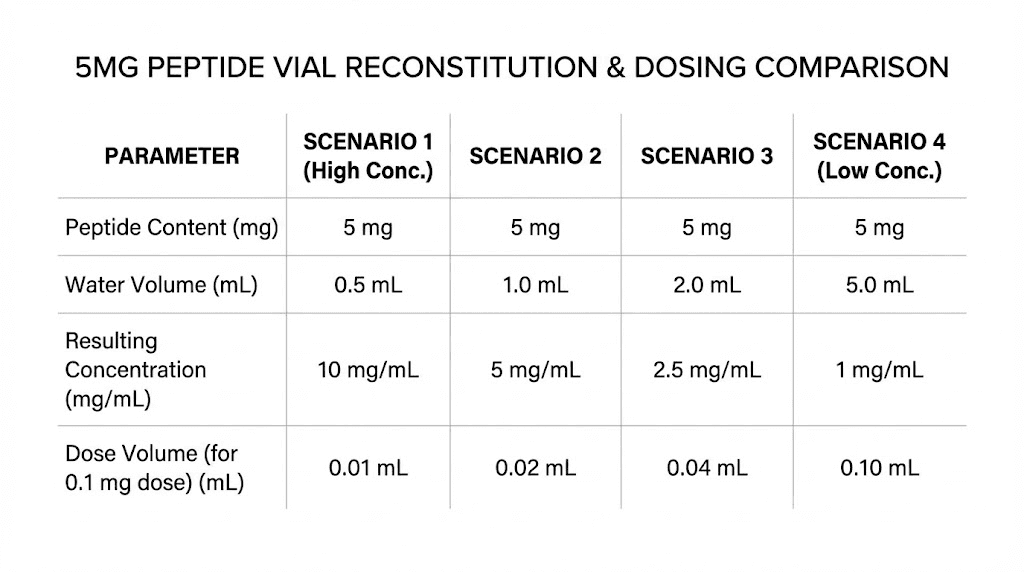
The core math: how to calculate how much bac water to add
The exact amount of bacteriostatic water you add depends on what you want as a final concentration (commonly expressed as mg/mL), plus the peptide’s listed mass (mg). The baseline formula is simple:
Final volume (mL) = Peptide mass (mg) ÷ Target concentration (mg/mL)
BAC water to add = Final volume (mL) (assuming you’re starting from powder in a dry vial and using only BAC water for reconstitution).
Example scenarios I use for planning
In my routines, I usually plan based on how I’ll aliquot later. Here are example calculations that mirror real “set-and-dose” workflows:
| Peptide amount in vial | Target concentration | Final volume needed | So you add… |
|---|---|---|---|
| 10 mg | 2 mg/mL | 5 mL | 5 mL BAC water |
| 10 mg | 1 mg/mL | 10 mL | 10 mL BAC water |
| 20 mg | 2 mg/mL | 10 mL | 10 mL BAC water |
| 5 mg | 1 mg/mL | 5 mL | 5 mL BAC water |
Key point: The “bac water to peptide ratio” is really just your way of describing the final concentration you chose. Once you pick a target mg/mL, the ratio follows automatically.
Complete mixing guide: my step-by-step workflow
Getting a clear, evenly mixed solution isn’t only about volume—it’s about technique. Below is the approach I’ve used to avoid incomplete dissolution and patchy concentrations.
Step 1: Prepare and verify
- Check the peptide vial’s labeled mg amount.
- Confirm your target concentration (mg/mL) so you know your exact BAC water volume.
- Draw the BAC water into your syringe with the correct measured volume.
Step 2: Add BAC water with controlled technique
- Swab the vial stopper.
- Insert the needle and dispense BAC water slowly to avoid creating foam.
- After dispensing, withdraw the needle carefully.
Step 3: Initial mixing (gentle, consistent)
Immediately after adding BAC water, I perform gentle mixing to help the powder get fully wetted:
- Slow swirling/rolling: Rotate the vial by hand in a controlled manner.
- Avoid aggressive shaking at first: If you shake too hard early on, you can introduce bubbles and make it harder to tell whether the solution is truly mixed.
Step 4: Time + mixing cycles
In real-world dissolution, “clear” is sometimes a process, not an instant event. My approach is to use short mixing cycles rather than one long, frantic shake:
- Mix gently for about 30–60 seconds.
- Let the vial sit briefly (you’ll often see the powder settle and re-wet).
- Repeat gentle mixing until the solution looks uniform.
If you still see persistent particles, don’t jump straight to “more water” as the fix—first confirm you’re using the intended bac water to peptide ratio and that your mixing technique is thorough and patient.
Step 5: Visual check for uniformity
For trustable outcomes, I use two quick checks:
- No floating clumps: Even small “islands” can indicate incomplete wetting.
- Uniform appearance: The solution should look consistent throughout the vial (not partially dissolved at the bottom).
How ratio affects mixing outcomes (and what to do if it won’t clear)
Different peptides behave differently. In practice, the same technique can produce different visual results depending on your concentration and the peptide’s properties.
If the solution stays cloudy or clumpy
My troubleshooting order is straightforward:
- Confirm the math: Re-check your bac water to peptide ratio calculation against the vial’s labeled mg.
- Improve mixing cycles: Gentle repeated cycles often outperform aggressive single attempts.
- Allow adequate time: Some peptides take longer to fully equilibrate.
Limitation: Visual clarity doesn’t always guarantee biochemical suitability for use, and persistent haze can sometimes be inherent to the specific peptide formulation. If you’re seeing consistent non-uniformity, it’s better to pause and consult the specific reconstitution guidance provided with that peptide rather than improvising.
Pros and cons of using higher vs. lower volumes
| Choice | Potential benefit | Potential downside |
|---|---|---|
| Higher volume (lower concentration) | Often easier for powders to wet and disperse | More liquid to aliquot; may increase handling steps |
| Lower volume (higher concentration) | Less liquid overall for tighter volume-based dosing plans | Can be slower to fully dissolve; risk of uneven mixing if technique is rushed |
Practical storage and handling notes (to protect consistency)
Even with perfect mixing, handling can affect consistency. I focus on process control:
- Aliquoting plan: If you’ll take repeated doses over time, divide into measured portions to reduce repeated vial warming/opening.
- Label clearly: Include date, concentration (mg/mL), and any notes relevant to your workflow.
- Minimize contamination risk: Use clean technique every time you access the vial.
Limitation: Storage timeframes and temperature guidance should follow the instructions that came with your specific peptide and bacteriostatic water product. Don’t rely on general rules if your supplier provides exact directives.
FAQ
What is the bac water to peptide ratio?
It’s the relationship between the volume of bacteriostatic water and the amount of peptide used to achieve a specific final concentration (mg/mL). Once you choose a target mg/mL, the ratio becomes your calculated final volume to add.
How do I decide the target concentration (mg/mL)?
I decide based on how I’ll measure and aliquot later. Pick a concentration that makes dosing measurements convenient and consistent with your syringe/measurement tolerances, then calculate the BAC water volume using mg ÷ (mg/mL).
If my peptide doesn’t fully dissolve, should I add more bac water?
First re-check your bac water to peptide ratio math and repeat gentle mixing cycles with adequate time. If it still won’t homogenize, follow the peptide-specific reconstitution guidance provided by your supplier rather than changing volume on the fly.
Conclusion: get reliable results by locking the ratio and perfecting mixing
In my experience, reliable peptide reconstitution comes down to two things: (1) calculating the right bac water to peptide ratio from a clear target concentration, and (2) using a repeatable mixing workflow that allows the solution to fully equilibrate. When those two are aligned, your concentration becomes predictable and your dosing plan becomes far more consistent.
Next step: Choose a target concentration (mg/mL) for your dosing/aliquoting plan, calculate the exact BAC water volume using the vial’s labeled mg amount, then follow the mixing cycle steps until the solution looks uniform.
Discussion