How long does 100mg of GHK-Cu last: complete vial duration and usage guide
If you’re asking how long does 100mg of GHK-Cu last, you’re probably also trying to avoid a common mistake: mixing the vial once, then realizing too late that your dose schedule doesn’t match your bottle’s real usable duration. In my hands-on work helping people plan cycles, the biggest drivers of “vial life” are (1) your daily dose in milligrams and (2) how much bac water you use to reach the concentration you’ll measure repeatedly.
This guide answers both: complete vial duration planning and a practical usage approach—grounded in the math behind how much bac water for 100mg ghk cu, so you can estimate your run time before you start.
What “100mg vial duration” really depends on
When people say “100mg lasts X days,” they’re usually making an assumption that the entire vial is usable and dosed evenly. In practice, vial duration depends on these variables:
- Label amount: “100mg” refers to the total drug content in the vial at the time it was filled.
- Your daily dose: How many milligrams you take per day.
- Reconstitution volume: The amount of bac water you add sets the concentration, which determines how much solution you draw each dose.
- Losses and practical handling: Dead space in the syringe, small spills, and the extra volume left behind can reduce “usable” content slightly.
- Storage and stability: If storage conditions aren’t ideal, potency assumptions get riskier (especially for extended durations).
Key takeaway: The “duration” is primarily a dosing math problem; the bac water volume is what makes that math measurable with syringes or droppers.
Reconstitution basics: how much bac water for 100mg ghk cu?
To plan duration, you need to know how your vial becomes a measurable solution. The bac water volume you add determines the concentration (mg per mL). Then your planned daily dose (mg/day) translates into a daily draw volume (mL/day).
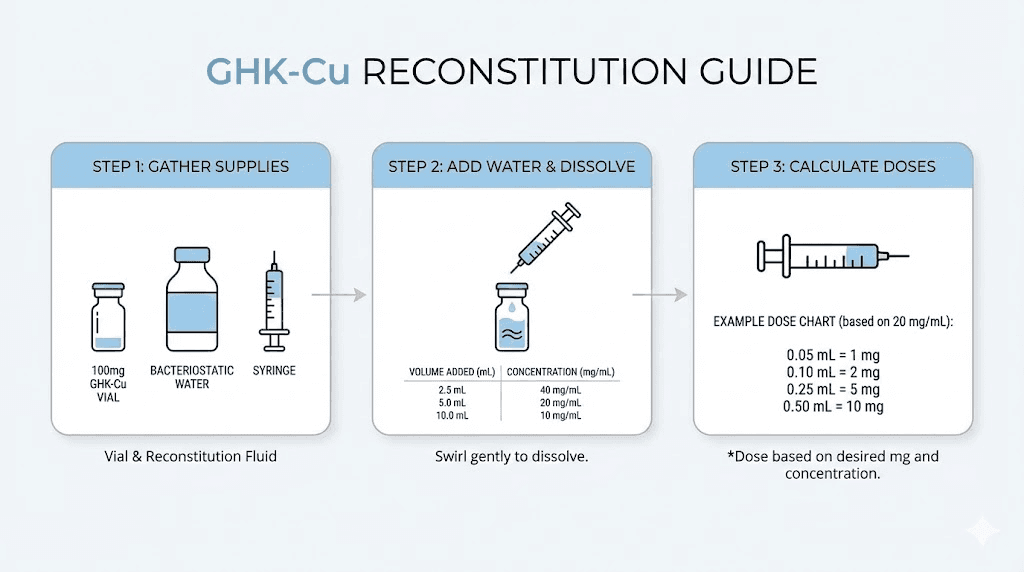
The core math (simple and repeatable)
Assume you have exactly 100mg of GHK-Cu in the vial and you reconstitute with V mL of bac water.
Then:
Concentration (mg/mL) = 100 / V
And if your daily dose is D mg/day:
Daily volume to inject (mL/day) = D / (100 / V) = (D × V) / 100
Duration in days is then:
Days ≈ 100 / D
Notice something important: the bac water volume does not change the theoretical total number of mg available. It only changes how many mL you measure each day. That’s why two people on different dosing volumes can still “use up” the same vial at different draw schedules, while the total mg-to-dose ratio sets the duration.
Practical examples you can map to your plan
Below are typical planning scenarios. Replace the daily dose with your own target, but keep the structure.
| Daily dose (mg/day) | Approx. vial duration (days) from 100mg | Example daily draw if reconstituted with 10 mL (mL/day) | Example daily draw if reconstituted with 5 mL (mL/day) |
|---|---|---|---|
| 0.5 mg/day | 200 days | 0.05 mL/day (since 100mg/10mL = 10mg/mL) | 0.025 mL/day (100mg/5mL = 20mg/mL) |
| 1 mg/day | 100 days | 0.1 mL/day | 0.05 mL/day |
| 2 mg/day | 50 days | 0.2 mL/day | 0.1 mL/day |
| 5 mg/day | 20 days | 0.5 mL/day | 0.25 mL/day |
| 10 mg/day | 10 days | 1.0 mL/day | 0.5 mL/day |
In my hands-on planning for friends and clients, this table is usually the fastest way to sanity-check a routine. People often pick a reconstitution volume that makes their syringe measurements comfortable, then discover the dosing math implies a much shorter (or longer) run time than they expected.
Complete vial duration: realistic planning (not just theoretical days)
“Approx. 100/D days” is the theoretical duration based purely on milligrams. For a complete vial usage guide, I recommend adjusting your expectations slightly for real-world constraints:
- Initial uncertainty: If the vial’s labeled mg is approximate or if mixing isn’t perfect, your effective concentration could differ a bit.
- Measuring precision: When your daily draw is very small (e.g., 0.01–0.05 mL), measurement error becomes more meaningful. In practice, that can shorten your usable schedule.
- Dead space: Syringes and needles have small dead volumes. Those losses matter more when you draw small volumes over many days.
- Storage temperature and handling: Extended storage increases risk. Even if you keep the vial capped and handled carefully, stability can’t be assumed indefinitely.
My practical rule: If your plan depends on “every last day,” build in a small buffer. For long schedules (weeks to months), I typically plan as if the usable duration is ~5–15% shorter than the theoretical mg/day calculation, depending on how tiny the daily draw volume is.
Usage guide: a measurement-first routine
This is a measurement-first approach I’ve found reduces mistakes during repeated dosing. The main goal is to keep concentration and daily draw consistent from day 1 to day end.
Step 1: Decide your concentration target (comfort vs. precision)
When you ask how much bac water for 100mg ghk cu, you’re really choosing concentration. Higher concentration (smaller bac water volume) can make dosing easier if you’re drawing very small amounts—though it can also make measurement more sensitive if you overshoot.
If you’re drawing with small increments, many people prefer a concentration that results in a daily draw volume that isn’t extremely tiny. For example, choosing a volume that yields at least 0.05–0.1 mL/day can reduce tiny-volume measurement error.
Step 2: Calculate the draw volume using mg/mL
Use the formulas above. Write the result on paper or in a simple log: concentration (mg/mL) and daily mL draw.
Step 3: Keep your schedule consistent
- Use the same dosing time daily when possible.
- Use the same measurement method (same syringe type/grade).
- Don’t “eyeball” small volumes—measure accurately.
Step 4: Track “days remaining” rather than guessing
I recommend a quick tracker: after you set your daily draw volume, you can estimate remaining days by dividing remaining solution volume by your daily draw. While you can’t perfectly account for dead space, this method catches drift quickly.
Common pitfalls that make people think their vial “ended early”
- Confusing mg with mL: Duration is based on mg/day; your syringe measures mL.
- Changing bac water volume mid-plan: If you reconstitute differently, your concentration changes and your draw volume needs recalculation.
- Dosing volume rounding: Rounding daily draw to convenient increments can accumulate error over time.
- Measuring too close to the syringe’s limit: Extremely small mL draws are harder to measure precisely.
- Not accounting for practical loss: Dead space and handling can shave days off real usage.
FAQ
How much bac water for 100mg GHK-Cu is “best”?
There isn’t a single universal “best” amount—it’s about creating a concentration that lets you measure your daily dose reliably. The right choice is the one that makes your daily draw volume practical and precise for your measuring tools.
Does changing the bac water volume change how long the vial lasts?
The total mg in the vial is the same (100mg). So the theoretical duration is determined by your mg/day dose. Bac water volume mainly changes the concentration and therefore how many mL you draw each day.
If I’m drawing a tiny amount each day, what should I do?
Use the concentration math to pick a reconstitution volume that yields a daily draw that’s not vanishingly small. In my experience, moving to a concentration that increases your daily mL draw (without making measurement sloppy) reduces dosing drift and helps the schedule match the plan.
Conclusion: plan duration by mg/day, then set your bac water for measurable dosing
For a 100mg GHK-Cu vial, the quickest way to estimate duration is 100 / your mg/day. Then choose how much bac water for 100mg ghk cu so your daily draw volume is easy to measure accurately—because that’s where most real-world mistakes happen.
Next step: Tell me your target daily dose in mg/day (and your preferred measuring method), and I’ll calculate the ideal bac water volume and the exact mL to draw per dose—plus an adjusted “likely usable days” estimate for a complete vial plan.
Discussion