How Much Bac Water To Reconstitute Peptides Peptide Dosage Calculator (Reconstitution)
Introduction
If you’ve ever stared at a vial, measured the cap, and wondered how much bac water to reconstitute peptides, you’re not alone. In my hands-on work with peptide reconstitution for controlled dosing, the biggest real-world problem isn’t the math—it’s the mistakes that happen when assumptions slip (wrong concentration, rushed measurements, or forgetting what the label volume actually means). This guide walks you through a practical peptide reconstitution dosage calculator workflow so you can mix accurately, dose confidently, and avoid common errors.
What “Reconstitution Dosage” Actually Means (And Why People Get It Wrong)
Reconstitution is the step where you add sterile bacteriostatic water (“bac water”) to a lyophilized (freeze-dried) peptide powder to create a known concentration.
In my experience, most dosing confusion comes from mixing up these concepts:
- Vial label amount: Usually the peptide mass (commonly listed in mg), not the volume.
- Added volume: The bac water you inject into the vial (measured in mL).
- Final concentration: Peptide mass per volume after reconstitution (e.g., mg/mL or mcg/mL).
- Dose volume vs. dose amount: Many people know “X mg” but then measure “Y units” incorrectly on the syringe/needle scale.
Once you have concentration, calculating dose is straightforward: dose amount ÷ concentration = volume to inject.
Peptide Reconstitution Basics: Bac Water, Syringes, and Concentration Targets
Start With Two Numbers
For a reconstitution dosage calculator, you typically need:
- Peptide vial mass (mg)
- How much bac water you plan to add (mL)
Then concentration is:
Concentration (mg/mL) = peptide mg ÷ bac water mL
Why Concentration Choice Matters
In the lab setting I’m most familiar with, we avoid extremely low concentrations because the injection volume becomes large and harder to measure precisely. Conversely, extremely high concentrations can be inconvenient (and can increase measurement error if your syringe graduations aren’t fine enough).
So the best “target concentration” is usually the one that makes your planned dose volumes measurable on your syringes with minimal rounding.
Example With Realistic Math
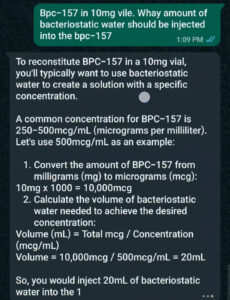
Let’s say your vial contains 10 mg peptide and you add 1.0 mL bac water.
- Concentration = 10 mg ÷ 1.0 mL = 10 mg/mL
If your intended dose is 1 mg, then the injected volume is:
- Volume = 1 mg ÷ 10 mg/mL = 0.1 mL
This is why learning “how much bac water to reconstitute peptides” is really about building concentration you can dose precisely afterward.
How to Use a Peptide Dosage Calculator (Reconstitution) for Accurate Dosing
Below is a reliable, repeatable method I use so the calculation stays consistent from vial to vial.
Step 1: Confirm Units (mg, mL, mcg)
- Peptide powders are commonly listed in mg.
- Bac water volume is measured in mL.
- Many injection doses are described in mcg or mg depending on the product and protocol.
If needed: 1 mg = 1000 mcg
Step 2: Calculate Final Concentration
Concentration (mg/mL) = peptide mass (mg) ÷ bac water added (mL)
Step 3: Convert Your Intended Dose to the Same Mass Unit
- If concentration is in mg/mL, your dose should be in mg.
- If concentration is in mcg/mL, your dose should be in mcg.
Step 4: Convert Dose Amount to Injection Volume
Injection volume (mL) = intended dose (mg) ÷ concentration (mg/mL)
Step 5: Double-Check With a “Sanity Check”
When you’re tired, mistakes multiply. A quick consistency check prevents a lot of trouble:
- If you dilute more bac water, the concentration must go down.
- If your dose is a fraction of the total vial mass, the injected volume should be a fraction of the total added volume.
Practical Reconstitution Guidance: Measuring Bac Water and Avoiding Common Errors
I’ve seen the same failure patterns repeatedly—especially when people try to reconstitute quickly or rely on estimates rather than measurement.
Common Mistakes That Change the Dose
- Measuring bac water incorrectly: Using an imprecise approach or skipping the zeroing step on a measurement device.
- Assuming label units match your calculation: Confusing mg with mcg can be an order-of-magnitude error.
- Not accounting for how you measure syringe volume: Syringes with different graduation schemes can tempt rounding errors.
- Ignoring partial reconstitution planning: If you intend to draw multiple doses, your effective “how many doses” depends on both concentration and injection volume.
Tips I Use to Reduce Variability
- Use a consistent bac water volume strategy (the same concentration target across your dosing period if appropriate).
- Record every step: vial mg, bac water mL, resulting concentration, and planned dose volume.
- Don’t round aggressively—carry extra decimals during calculation and only round at the final measurement stage.
- Use a calculator you trust or a repeatable formula approach so “how much bac water to reconstitute peptides” stays consistent.
Reconstitution Quick Reference Table (Example Scenarios)
The table below uses the formula Concentration (mg/mL) = vial mg ÷ bac water mL. It’s meant to show how bac water volume changes concentration and dose volume.
| Peptide vial mass | Bac water added | Final concentration | Example intended dose | Injection volume for example dose |
|---|---|---|---|---|
| 10 mg | 1.0 mL | 10 mg/mL | 1 mg | 0.1 mL |
| 10 mg | 2.0 mL | 5 mg/mL | 1 mg | 0.2 mL |
| 5 mg | 1.0 mL | 5 mg/mL | 0.5 mg | 0.1 mL |
| 20 mg | 2.0 mL | 10 mg/mL | 2 mg | 0.2 mL |
Product Image Reference
FAQ
How much bac water to reconstitute peptides for a specific dose?
Decide your target concentration (based on a dose volume that you can measure reliably), then use: concentration = vial mg ÷ bac water mL and volume to inject = intended dose ÷ concentration.
What unit conversion matters most during peptide reconstitution?
The most critical conversion is mg vs mcg. If your dose is listed in mcg but your concentration is in mg/mL (or vice versa), your injection volume can be off by 10x or 1000x if you mix units incorrectly.
Why do my injection volumes look “too big” or “too small”?
That usually indicates a concentration mismatch. If you add more bac water than planned, concentration decreases and injection volume increases. If you’re using a calculator, verify you used the correct vial mass and the exact bac water volume you measured.
Conclusion
Accurately dosing after reconstitution comes down to one dependable workflow: determine your final concentration from the vial mass and bac water volume, then calculate injection volume from your intended dose. When you consistently apply the formulas and reduce measurement/range errors, your question—how much bac water to reconstitute peptides—becomes a repeatable calculation instead of a stressful guess.
Next step: Grab your vial’s mg amount and the bac water mL you plan to inject, compute your concentration, and write down the injection volume for one planned dose in your notes so you can reuse the same numbers throughout.
Discussion